iPhone 18 Rumor Roundup: Release Date Shifts, 2nm A20 Chips, and the Death of the Dynamic Island (2026 Preview)
Everything we know about the Apple iPhone 18 series (2026). From the revolutionary 2nm A20 chip and variable aperture cameras to the rumored "split launch" strategy—here is your ultimate guide.
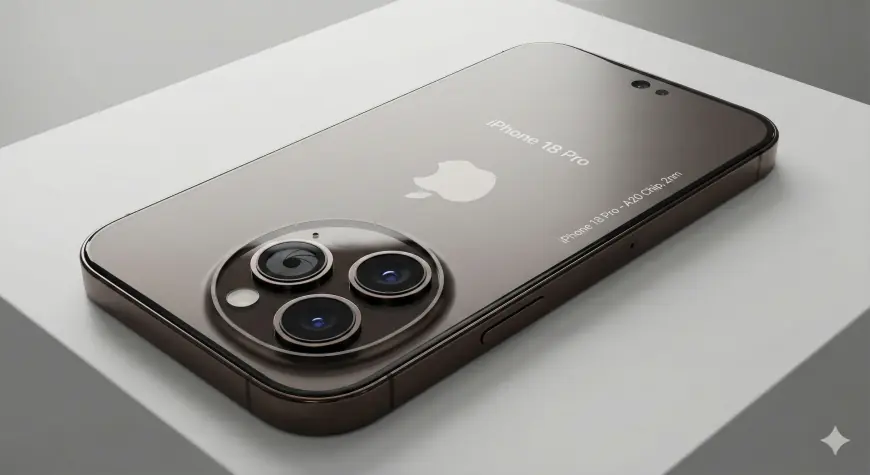
The iPhone 18 Series: A Complete Guide to Apple’s 2026 Super-Cycle
The tech world moves fast. While most consumers are still getting used to the latest iPhone features in their pockets, the supply chain never sleeps. We are already seeing concrete leaks and credible supply chain reports regarding Apple’s 2026 lineup: the iPhone 18 series.
If reliable industry analysts like Ming-Chi Kuo and Bloomberg’s Mark Gurman are to be believed, 2026 won’t just be another incremental upgrade year. Instead, the iPhone 18 is shaping up to be a "Super Cycle"—a massive leap forward in processing power, camera physics, and display technology that could fundamentally change how we use our devices.
From the introduction of 2-nanometer chip technology to the potential end of the Dynamic Island, here is an exhaustive, deep-dive preview of what awaits us in the iPhone 18, iPhone 18 Pro, and iPhone 18 Pro Max.
1. The Release Date Shake-Up: A New Strategy for 2026?
For over a decade, you could set your watch by Apple’s release schedule: a keynote in the first or second week of September, followed by a global launch ten days later. However, rumors circulating in Q4 2025 suggest that the iPhone 18 series might disrupt this tradition.
The "Split Launch" Theory
Sources suggest that as iPhone technology becomes more complex to manufacture—specifically the cutting-edge Pro displays and next-gen chipsets—Apple may move to a staggered release cycle to alleviate supply chain pressure and maintain sales momentum year-round.
-
September 2026: This slot is reserved for the heavy hitters—the iPhone 18 Pro and iPhone 18 Pro Max. These devices will debut the newest tech first to justify their premium price tags.
-
Spring 2027: The standard iPhone 18 and the rumored budget-friendly iPhone 18e might be pushed to early 2027. This allows the Pro models to have exclusivity on new features for six months.
This strategy mirrors what Apple has done with its iPad and Mac lineups, separating "Pro" and "Air" launches to keep the brand in the news cycle all year long.
2. Performance: The 2nm A20 Chip Revolution
If there is one reason to wait for the iPhone 18, it is the processor. The iPhone 18 series is expected to be the launchpad for the A20 Bionic chip, which will likely be built on TSMC’s 2-nanometer (2nm) N2 process.
Why "2nm" is a Big Deal
To understand why this matters, we have to look at physics. The current generation of chips uses 3nm technology. By shrinking the transistors down to 2nm, Apple can pack billions more transistors onto the same size slice of silicon.
-
Efficiency Gains: Early reports indicate the N2 process could offer 25-30% better power efficiency than the 3nm chips found in the iPhone 16/17 eras. This means significantly longer battery life without increasing the battery size.
-
Performance Jumps: We aren't just looking at marginal gains. The A20 is expected to handle on-device AI (Apple Intelligence) much faster, processing complex LLM (Large Language Model) tasks locally without needing to ping the cloud.
The Custom Apple 5G Modem
For years, Apple has relied on Qualcomm for its 5G connectivity. The iPhone 18 is widely tipped to be the device where Apple finally cuts that cord. The device is expected to feature Apple's proprietary in-house 5G Wi-Fi chip. This integration allows the modem to communicate directly with the A20 processor more efficiently, potentially solving the battery drain issues users often face when using 5G heavily.
3. Design and Display: The "Perfect Rectangle"
The quest for the all-screen phone—a single slab of glass with no notches, cutouts, or interruptions—has been Apple’s goal since the iPhone X. The iPhone 18 Pro might be the device that finally achieves it.
Under-Display Face ID
According to display industry consultant Ross Young, 2026 is the target year for Apple to move the Face ID IR sensors and dot projector under the display.
What does this mean for the look of the phone?
-
The Pro Models: The large pill-shaped "Dynamic Island" could shrink to a simple, tiny circular punch-hole for the selfie camera. The rest of the sensors will be invisible, lurking beneath the pixels, activating only when you look at your phone.
-
The Standard Models: The base iPhone 18 will likely retain the current Dynamic Island design, further differentiating the Pro line.
120Hz ProMotion for Everyone (Finally)
A major point of contention for Apple fans has been the 60Hz screens on base model iPhones. By 2026, the supply chain costs for LTPO (Low-Temperature Polycrystalline Oxide) panels will have dropped significantly. It is highly probable that the standard iPhone 18 will finally feature 120Hz ProMotion, offering that buttery-smooth scrolling experience that Android users have enjoyed on mid-range phones for years.
4. Camera: The Era of Variable Aperture
Smartphone photography has hit a ceiling where simply adding "more megapixels" doesn't necessarily result in better photos. Apple knows this, which is why the iPhone 18 Pro is rumored to introduce a mechanical change: Variable Aperture.
Mechanized Optics
Currently, iPhone lenses have a fixed aperture (usually around f/1.7 or f/2.8). This is great for low light but can result in a depth of field that is too shallow for group photos or documents. The iPhone 18 Pro’s main wide camera is expected to switch between apertures mechanically.
-
f/1.5 Mode: For low light and creamy background blur (bokeh) in portraits.
-
f/2.4 Mode: For landscapes and group shots where you want everything in focus.
This brings the iPhone camera much closer to the versatility of a dedicated DSLR or Mirrorless camera.
The 200MP Rumor
While Apple has historically been conservative with megapixels (sticking to 12MP for years before jumping to 48MP), the telephoto or ultra-wide lens on the iPhone 18 Pro Max may jump to a massive sensor—potentially 200MP—in partnership with Samsung or Sony. This would allow for "hybrid zoom" capabilities that make digital cropping look almost identical to optical zoom.
5. Software: iOS 20 and Deep AI Integration
The iPhone 18 will launch alongside iOS 20, a milestone operating system update.
By 2026, "Apple Intelligence" will no longer be a beta feature or a gimmick; it will be the core of the OS. With the NPU (Neural Processing Unit) capabilities of the A20 chip, we can expect:
-
Generative Siri: A voice assistant that can actually hold a conversation, remember context from weeks ago, and perform multi-app tasks (e.g., "Siri, take the photos I took at the restaurant last night and email them to Mike with the subject line 'Dinner'").
-
Real-Time Visual Editing: The ability to edit video in real-time using generative AI to remove objects or change backgrounds while recording.
6. Battery Life and Charging Speeds
Battery anxiety is the number one complaint of smartphone users. The iPhone 18 series looks to address this with Stacked Battery Technology.
Borrowing tech from the electric vehicle (EV) industry, stacked batteries allow for higher energy density in the same physical space.
-
Capacity: We could see the iPhone 18 Pro Max exceed 5,500 mAh, effectively becoming a 2-day phone for average users.
-
Charging: With bigger batteries comes the need for speed. Rumors point to Apple finally moving past the 27W-30W charging cap, potentially offering 45W or 60W wired charging. This would allow a 0% to 50% charge in under 15 minutes.
7. The "Ultra" Wildcard: Is There a New Tier?
For years, whispers of an "iPhone Ultra" have floated around the tech sphere. Could 2026 be the year?
Some leaks suggest that the iPhone 18 Pro Max is getting too big and too expensive, and Apple might introduce a new top-tier model specifically for creators. An iPhone 18 Ultra could feature:
-
A Titanium-Gold alloy chassis.
-
Quad-camera setup (adding a second telephoto lens).
-
Storage starting at 2TB.
While this remains the most speculative part of the rumor mill, Apple’s push into "Ultra" branding with the Apple Watch makes it a strong possibility.
8. Price Prediction: Prepare Your Wallets
Technology isn't getting cheaper. The move to 2nm fabrication is incredibly expensive for manufacturers like TSMC, and those costs are invariably passed down to the consumer.
-
iPhone 18: Likely to stay around $799 - $899.
-
iPhone 18 Pro: Could see a price hike to $1,099.
-
iPhone 18 Pro Max: Might start at $1,299.
While these prices are steep, Apple’s trade-in programs and carrier deals often soften the blow.
Conclusion: Should You Wait for 2026?
If you are currently holding an iPhone 15 or 16, the iPhone 18 represents the "perfect storm" of upgrades. It is rare for a single generation to offer a new chip architecture (2nm), a new display technology (Under-display Face ID), and a new camera mechanic (Variable Aperture) all at once.
The iPhone 18 series is shaping up to be one of the most significant leaps in iPhone history. While 2026 feels far away, in the world of tech development, it is just around the corner. Start saving now—because this is the upgrade you’re going to want.