
Sudan Crisis Deepens: Satellite Imagery Confirms Mass Graves, Ethnic Cleansing in El-Fasher
New satellite analysis from Yale reveals mass graves and systematic killings in El-Fasher, Sudan, as the UN calls it the world's worst humanitarian crisis with millions displaced and thousands dead.
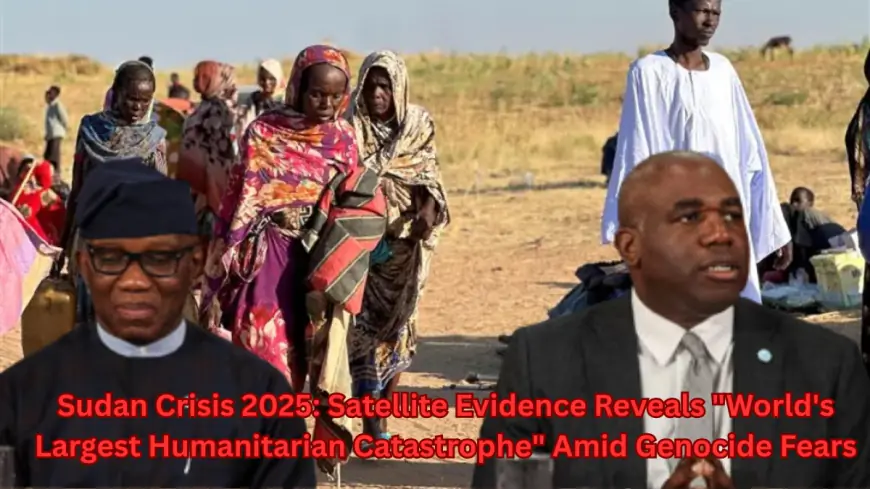
Satellite Images Confirm Mass Graves, Systematic Killings in Sudan's El-Fasher as Crisis Deepens
El-Fasher, Sudan, December 1, 2025 – The devastating conflict in Sudan has escalated to what the United Nations now labels the "world’s largest humanitarian catastrophe." Grim satellite imagery from El-Fasher depicts "red patches from blood pools around body mounds," offering chilling evidence of systematic violence, including mass graves and targeted killings. This comes as the UN confirms thousands dead and millions displaced in a crisis that continues to shock global observers.
The Unfolding Tragedy: New Evidence of Ethnic Cleansing
A bombshell report released by Yale University's Humanitarian Research Lab on October 27, 2025, provided irrefutable satellite analysis of El-Fasher. The images corroborate widespread allegations of mass graves and systematic killings, with non-Arab tribes reportedly facing targeted ethnic cleansing. Eyewitness accounts suggest homes are being raided one by one, signaling a deliberate campaign rather than random violence. Over 1,500 people are reported to have died in just three days following the Rapid Support Forces (RSF) seizure of the city on October 26.
Geopolitical Stakes: Why Sudan Matters Beyond Its Borders
Sudan's strategic location in northern Africa, bridging the continent and the Middle East, gives the crisis significant geopolitical weight. Bordering Egypt, Libya, Chad, and the Red Sea, the nation controls crucial trade routes and valuable resources. The unfolding chaos therefore carries far-reaching implications for regional stability and global interests, underscoring the urgent need to understand the conflict's complex roots.
A Nation of Paradox: Wealth, Instability, and Division
Home to approximately 50 million people, Sudan’s demographics are marked by a 70% Arab Muslim majority and 30% from diverse African tribes, including Fur, Zaghawa, Berti, and Nuba, predominantly Sunni Muslim with small Christian and traditional faith minorities.
Despite being Africa's third-largest gold producer, with over 60,000 kg extracted annually, Sudan remains one of the poorest nations globally. An estimated 90% of its gold production is illicitly smuggled out, depriving the government of vital revenue and reportedly funding armed factions. This paradox of vast natural wealth coexisting with extreme poverty fuels the ongoing instability.
Decades of authoritarian rule have also plagued Sudan since its independence from British-Egyptian rule in 1956. General Omar al-Bashir's 30-year iron-fisted rule, marked by corruption and civil wars, culminated in South Sudan's secession in 2011, severely crippling the national economy, which saw its GDP shrink for 17 consecutive years prior to the current conflict.
From Protest to Civil War: The Power Vacuum Ignites
The seeds of the current conflict were sown in 2019 when widespread protests against al-Bashir led to his overthrow by then-army chief Abdel Fattah al-Burhan and RSF commander Mohamed Hamdan Dagalo. A civilian-military Sovereign Council was established, promising a transition to democracy.
However, these hopes were dashed in October 2021 when Burhan staged a coup, dissolving the council and seizing full control. Tensions rapidly escalated between the Sudanese Armed Forces (SAF) and the RSF, particularly over the integration of RSF into the regular army and control over lucrative gold mines.
The simmering conflict erupted into full-blown civil war on April 15, 2023. While early phases saw SAF air dominance, the RSF gained significant ground, seizing Khartoum and the presidential palace. By November 2025, the RSF maintains control over western regions, including Darfur and Kordofan, while SAF holds the north and east, raising fears of a de facto partition of the country.
The Return of Genocide: A Humanitarian Catastrophe Unfolds
The human cost of this war is staggering: over 150,000 dead and more than 10 million displaced, with schools and hospitals reduced to rubble. In Darfur and Kordofan, 375,000 people faced starvation by September 2025, prompting the World Food Program to warn of the "biggest hunger crisis in history" if fighting persists. The collapse of healthcare systems has also led to widespread outbreaks of cholera, dengue, and malaria.
Alarmingly, the conflict has seen the re-emergence of tactics reminiscent of the 2003 Darfur genocide. At that time, al-Bashir unleashed the Janjaweed militias (later rebranded as the RSF, with Dagalo as a key commander) against non-Arab tribes like the Fur, Masalit, and Zaghawa, resulting in 300,000 deaths and 2 million displaced.
Today, the RSF is accused of repeating these atrocities. Human Rights Watch documented the systematic cleansing of Masalit communities in El Geneina, where over 1,000 were killed between April and November 2023. The recent fall of El-Fasher in October 2025 has been immediately followed by reports of mass graves, with RSF fighters allegedly posting videos dancing amidst piles of corpses. While the RSF claims these are tribal clashes, evidence points to an organized purge aimed at creating an "Arab-only" Darfur.
Both factions face accusations of war crimes, with SAF implicated in civilian airstrikes and shelling. Al-Bashir, Burhan, and Dagalo, once allies in past conflicts, now stand accused of orchestrating devastating violence against their own people.
International Involvement and Geopolitical Stakes
Sudan's strategic location and rich resources, including its gold mines and proximity to Red Sea shipping lanes, draw significant international attention. Allegations persist of foreign powers supplying arms to both sides. Amnesty International has named Russia, China, Turkey, and the UAE as key suppliers, with the Wall Street Journal citing US intelligence on Chinese drones reportedly flown in by the UAE for the RSF. The Sudanese army even filed a lawsuit against the UAE at the International Criminal Court in March 2025, which was dismissed.
Competing alliances see Iran, Egypt, and Saudi Arabia reportedly backing the SAF, while Russia's Wagner Group previously supported the RSF. While the RSF recently agreed to a three-month aid pause brokered by the US, Egypt, UAE, and Saudi Arabia, the SAF has yet to fully commit to such a cessation.
Conclusion: A Forgotten War on the Brink
The current Sudan crisis is largely attributed to the elite greed and power struggles of figures like al-Bashir, Burhan, and Dagalo. Their conflict has plunged a resource-rich nation into extreme poverty, with average incomes plummeting from $750 pre-war levels.
Despite the scale of the crisis, international aid efforts remain critically underfunded. The UN has received only $1.45 billion of the $4.2 billion needed for 30 million people, and UNHCR has secured a mere 35% of the $1.11 billion required for refugees. This "Forgotten War" continues as global powers prioritize their own strategic interests.
There is an urgent call for the three-month aid pause to be transformed into a permanent ceasefire, followed by immediate and extensive humanitarian aid mobilization to combat famine and disease. The international community is urged to act decisively to prevent further atrocities and avoid the emergence of another failed state in the region.