iPhone Fold (2026) Exclusive: Crease-Free Display, Self-Healing Screen, and a $2,500 Price Tag – Is Apple Finally Ready?
Apple's first foldable phone is coming. Discover the latest iPhone Fold leaks for 2026, featuring a revolutionary "self-healing" display, 2nm A20 chip, and a massive battery. Read the full rumors breakdown here
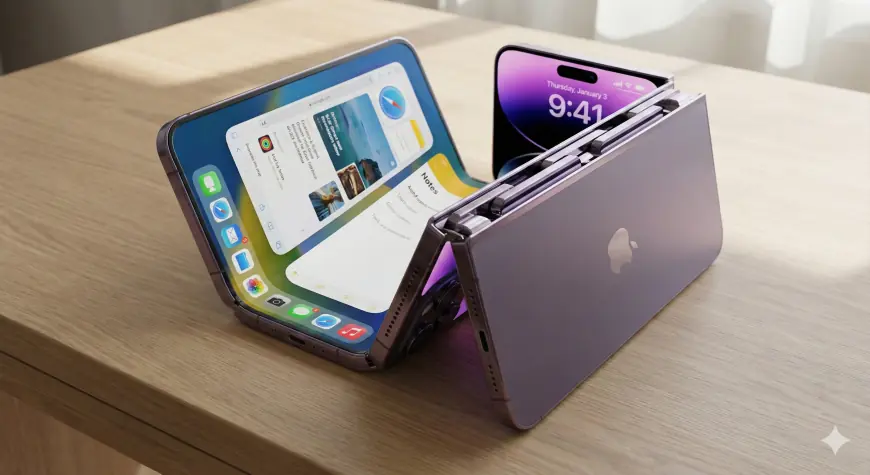
The iPhone Fold: Apple’s Most Ambitious Device Yet (2026 Preview)
For years, the smartphone industry has asked the same question: "Where is Apple?" While Samsung has refined its Galaxy Z Fold over six generations, and Google and OnePlus have entered the arena with impressive hardware, the Cupertino giant has remained silent.
But silence does not mean inactivity. Behind the closed doors of Apple Park, a revolution has been brewing. According to a surge of supply chain reports, patent filings, and analyst leaks in late 2025, Apple is finally preparing to unleash its answer to the foldable market: the iPhone Fold.
Scheduled tentatively for the September 2026 "Super Cycle," this device promises to solve the biggest complaints of current foldables—creases, durability, and battery life—while introducing a price tag that might make your eyes water.
Here is the definitive, deep-dive guide to everything we know about the Apple iPhone Fold.
1. The Release Date: Why the Long Wait?
To understand the iPhone Fold, you have to understand Apple’s philosophy: “Not first, but best.” Apple rarely invents a category; it perfects it.
-
The Timeline: Trusted analysts, including those from display supply chain firms, point to September 2026 as the target launch window. This coincides with the launch of the iPhone 18 Pro and iPhone 18 Pro Max.
-
The "Split Launch" Strategy: As mentioned in our previous coverage of the iPhone 18, Apple is rumored to be splitting its annual lineup. The iPhone Fold will likely serve as the "Ultra" tier flagship in the Fall, while standard iPhones may be pushed to early 2027.
Why 2026?
Why hasn't Apple launched one yet? Reports suggest that Apple engineers have been unhappy with the durability of current foldable panels. Apple’s standards for "drop test" survival are notoriously high. The company reportedly paused development multiple times until they could guarantee a screen that doesn't crack after 200,000 folds and a hinge that feels rigid, not flimsy.
2. Design: The "Crease-Free" Holy Grail
The most hated feature of any foldable phone is "The Crease"—that visible trench running down the middle of the screen where the glass folds. Apple is reportedly refusing to launch a device until this is invisible.
The "Self-Healing" Display Patent
One of the most exciting rumors comes from a patent filing discovered in 2025. It describes a display layer made of a custom polymer with "self-healing" properties.
-
How it works: Minor scratches and dents (common on soft foldable screens) would automatically fill in over time when exposed to heat or light.
-
Heated Hinge: Even wilder patents suggest a "heated display" mechanism that slightly warms the flexible pixels in freezing temperatures to prevent them from becoming brittle and cracking—a common issue for foldables in winter.
The Hinge Mechanism
Apple is designing a complex, interlocking hinge using liquid metal alloy. This material is stronger than titanium but can be molded into precise shapes.
-
The Goal: A completely flat fold with zero gap (which competitors have only recently achieved) and a hinge that can hold the phone open at any angle (Flex Mode) without wobbling.
3. Displays: A Canvas in Your Pocket
The iPhone Fold is expected to adopt the "Book Style" form factor (like the Galaxy Z Fold), rather than the "Clamshell" (Flip) style.
-
Outer Display: A standard 6.3-inch OLED panel. Crucially, rumors say this will have the same aspect ratio as a normal iPhone. Unlike the Samsung Z Fold, which can feel narrow and cramped, the closed iPhone Fold will feel exactly like using an iPhone 18.
-
Inner Display: A massive 7.8-inch or 8-inch Super Retina XDR display. When opened, it effectively becomes an iPad Mini.
-
ProMotion Everywhere: Both screens will feature 1Hz-120Hz LTPO technology, ensuring smooth scrolling and battery efficiency.
4. The Camera Revolution: Under-Display Tech
Foldable phones usually compromise on cameras because of space constraints. Apple aims to break this trend.
The Main System
The rear camera module is expected to mirror the iPhone 18 Pro, featuring:
-
48MP Main Sensor with Variable Aperture (f/1.5 - f/2.4).
-
48MP Ultra-Wide for high-resolution macro shots.
-
5x Telephoto Lens (Tetraprism design).
The Under-Display Camera (UDC)
This is the game-changer. Leaks suggest the inner display will have no notch and no punch-hole. Instead, Apple is testing a next-generation Under-Display Camera.
-
The Challenge: Current UDCs (like on the Galaxy Fold) take hazy, low-quality photos because the camera has to see through the screen pixels.
-
Apple's Solution: Apple is reportedly using a proprietary AI Image Signal Processor (ISP) in the A20 chip to reconstruct the image data, potentially offering the first UDC that is actually usable for FaceTime and selfies.
5. Performance: Powered by the 2nm A20
A foldable device requires immense processing power. It has to drive two screens, run multiple apps side-by-side, and manage heat in a thinner chassis.
-
The Chip: The iPhone Fold will run on the A20 Bionic (2nm).
-
Multitasking Beast: With the efficiency of the 2nm process, the chip can sustain high performance without thermal throttling. This is critical for "Pro" workflows, like editing 4K video on the large inner screen while checking emails on the side.
-
RAM: Expect 16GB of RAM as the standard. This is necessary to power the on-device AI features of Apple Intelligence that will run deeply throughout the OS.
6. Software: iOS or iPadOS?
This is where the iPhone Fold will live or die. Hardware is easy; software is hard. The device will likely run a hybrid OS, tentatively dubbed "iOS Fold" or a special mode within iOS 20.
Continuity is Key
Apple’s "Continuity" feature will be the star.
-
Universal Drag & Drop: Drag a file from an app on the left side of the screen and drop it into an email on the right.
-
App Pairs: Instantly launch your favorite duo of apps (e.g., Safari + Notes) with a single tap.
-
Tabletop Mode: Fold the phone halfway (L-shape). The bottom half becomes a keyboard or trackpad, while the top half acts as a monitor—perfect for quick typing sessions without a laptop.
7. Battery Life: The Largest iPhone Battery Ever
Foldables eat battery life. To combat this, leaks indicate Apple is using Stacked Battery Technology to utilize every millimeter of internal space.
-
Capacity: Rumors point to a split-cell battery design with a total capacity of 5,500 mAh to 5,800 mAh. This would be the largest battery ever put into an iPhone.
-
MagSafe: Enhanced MagSafe magnets will be placed on the back, likely supporting faster 25W Wireless Charging to top up the massive cells quickly.
8. Durability: No Case Needed?
Apple knows that if a $2,500 phone breaks, customers will riot.
-
Ceramic Shield 2.0: The outer glass will use a new generation of Ceramic Shield, toughened to resist cracks from 3-meter drops.
-
Dust Resistance: The Achilles heel of foldables. Apple is developing a sealed hinge that prevents dust and pocket lint from entering the mechanism, aiming for an IP68 rating—a rarity in the foldable world.
9. Price: The "Ultra" Premium
This is the hard part. All this technology—custom hinges, flexible glass, dual screens, 2nm chips—comes at a steep cost.
-
Estimated Price: Analysts predict a starting price of $2,399 - $2,500 (approx. ₹2,00,000+ in India).
-
The Audience: This is not a phone for everyone. It is a "Halo Device"—a show of force meant for enthusiasts, creators, and executives who want the absolute peak of technology and are willing to pay for it. It will likely sit above the iPhone 18 Pro Max in the lineup.
10. Conclusion: The "One More Thing" Moment
The iPhone Fold (or iPhone Ultra) represents the biggest form-factor change for Apple since the original iPhone in 2007.
Why you should be excited: If Apple pulls this off, they will have solved the durability and "crease" issues that have held foldables back from the mainstream. It could finally bridge the gap between iPhone and iPad, giving you a true digital workstation in your pocket.
Why you might worry: The price is astronomical, and first-generation Apple products (remember the original Apple Watch?) often have software quirks that take a year or two to iron out.
But one thing is certain: When Tim Cook finally walks on stage in September 2026 and unfolds this device, the smartphone world will change overnight.