
44 Years Later: Juliane Koepcke’s Incredible Story of Surviving a 10,000-Foot Fall and 11 Days Alone in the Peruvian Amazon
On Christmas Eve 1971, LANSA Flight 508 ripped apart mid-air. One passenger, Juliane Koepcke, survived the 10,000-foot fall and then spent 11 days alone in the jungle using her zoologist parents' knowledge
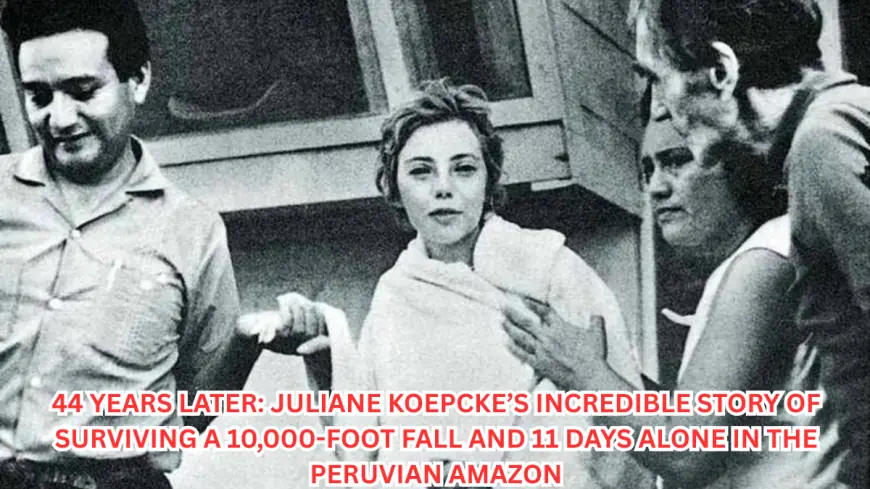
A Christmas Eve Tragedy and an Impossible Survival in the Peruvian Wilderness
Lima, Peru, December 1, 2025 – The story of Juliane Koepcke remains one of the most astonishing tales of human survival in modern history. On Christmas Eve 1971, the $17$-year-old was a passenger on LANSA Flight 508, a Lockheed L-188 Electra turboprop, flying from Lima to Pucallpa. As the plane flew over the dense Amazon rainforest, it was engulfed by a fierce storm. Lightning struck the right wing, causing the plane to rip apart mid-air at an altitude of 10,000 feet.
The airline, LANSA, already had a notorious safety record, but the sheer force of the mid-air disintegration led search teams to immediately presume no one could have survived. Yet, through an extraordinary confluence of luck and physics, Juliane Koepcke would become the sole survivor of the initial fall.
The Physics of an Impossible Survival
Juliane, seated in row 19F, survived the plunge while still buckled into her seat row, which broke free from the aircraft. Her impossible survival was attributed to three crucial factors:
-
Updrafts: Powerful storm updrafts helped slow the initial descent.
-
Rotation: Her seat row spun, similar to a helicopter blade, further reducing the speed of her fall.
-
Cushioning: The dense canopy of the Amazon rainforest, composed of thick vines and leaves, acted as a powerful natural net, cushioning her impact.
She awoke on Christmas morning alone in the jungle, severely injured with a snapped collarbone, a badly swollen ankle, a severe concussion, and one eye swollen shut. She was deep within the jungle, with no immediate hope of rescue.
Alone in the Green Hell: Juliane’s Journey
The official rescue operation was called off days later, with search teams unable to locate any radar signals or wreckage. Juliane, however, possessed a unique advantage: her parents were German zoologists who ran the nearby Panguana research station. Years spent with them gave her vital knowledge of the Amazonian ecosystem, enabling her to distinguish between non-poisonous and toxic plants and identify signs of dangerous animals.
On her third day, after finding a small spring, she recalled her father’s crucial survival rule: "Lost in the jungle? Find a stream. Follow it downhill. Streams join rivers. Rivers lead to people."
She followed the small stream as it swelled into a river, facing immense challenges:
-
Navigating Wreckage: She encountered turbine scrap and seats with the bodies of other crash victims, including three strapped bodies with their heads buried in the mud.
-
Environmental Dangers: She faced constant threats from cold, insects, and wildlife, including a confrontation with an alligator, which she survived by diving into the current.
-
Wounds: Maggots began to hatch in an arm wound, forcing her to endure agonizing pain to dig them out.
The Final Push to Salvation
By the sixth day, Juliane’s strength was fading. On day 10, completely exhausted, she reached a wide river where she saw a boat and what appeared to be a fisherman's hut on the shore. Believing it could be a hallucination, she forced herself to check.
The hut was real. Inside, she found petrol, which she poured onto her maggot-infested arm—a makeshift antiseptic that drove out over 30 larvae. She waited, and on the 11th day, three local loggers arrived. They initially feared she was a mythical water spirit (Yacumama) due to her shocking appearance.
Upon hearing her story and her identification as the LANSA crash survivor, the men were stunned, having believed all passengers were dead. They cleaned her wounds, fed her, and took her to a village, from where she was flown to a hospital and finally reunited with her father. It was only then she learned her mother had not survived the crash.
A Legacy of Knowledge and Resilience
The investigation later confirmed that 14 others had initially survived the crash but succumbed to their injuries or the jungle environment while waiting for rescue. Juliane’s victory was a direct result of her parents' lessons, her ability to remain calm, and her sheer determination to keep moving.
The ordeal left her with long-term post-traumatic stress disorder, but she channeled her experience into a professional life focused on conservation. She studied biology, became a zoologist, and took over the management of the Panguana research station in 2000. Now 71 years old in 2025, Juliane Koepcke continues her work in the Amazon, dedicating her life to saving the rainforest and the knowledge it holds. Her survival story stands as a powerful testament to the triumph of knowledge and resilience over overwhelming odds.