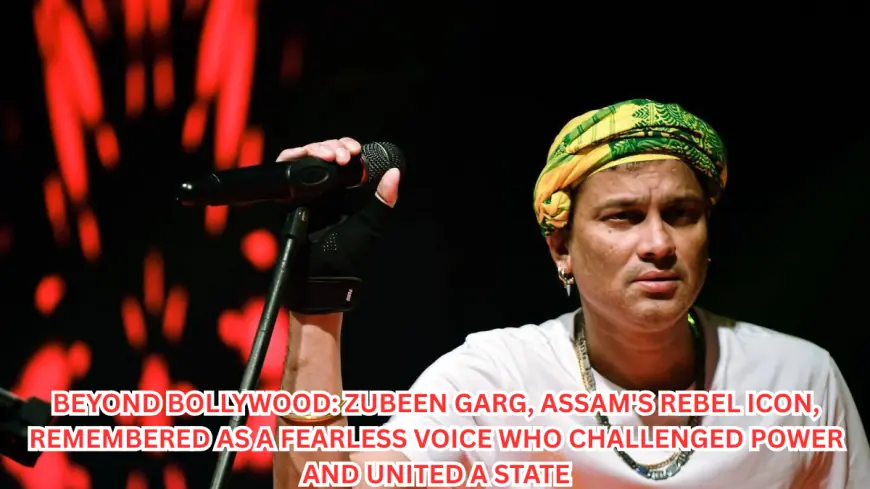
Beyond Bollywood: Zubeen Garg, Assam's Rebel Icon, Remembered as a Fearless Voice Who Challenged Power and United a State
The death of Zubeen Garg, who recorded over 38,000 songs, caused a state-wide mourning in Assam. He is celebrated as a "rebel" figure for his fearless political and social activism.
A State in Mourning: More Than a Singer
The death of Zubeen Garg on September 19, 2025, marked a historic day for Assam, triggering a massive public outpouring of grief that saw millions line the streets for his final viewing. The government declared three days of official mourning. This overwhelming reaction stems from the fact that Zubeen was far more than a musician who recorded over 38,000 songs in more than 40 languages, including the Bollywood hit "Ya Ali." He was a "real-life hero" and a "fighter" who used his voice to champion the people.
The Voice of a Generation in Crisis
Zubeen rose to fame in the early 1990s amidst a period of extreme violence and deep despair caused by the United Liberation Front of Assam (ULFA) insurgency and subsequent military operations.
-
Cultural Anchor: His first rock album, Anamika (1992), offered a message of love and hope that provided a much-needed emotional and cultural anchor for the youth.
-
Cultural Pride: He made it cool and aspirational to speak and sing in Assamese at a time when English was dominating, instilling a sense of cultural and political confidence in a generation grappling with globalization.
The Fearless Rebel
Zubeen was openly a rebel who was greatly inspired by Marxist revolutionary Che Guevara and refused to be co-opted by the establishment:
-
Challenging Politicians: He publicly stated that all ministers and leaders in Assam, regardless of their party (BJP or Congress), were corrupt and constantly challenged them on issues like misgovernance.
-
Against Religious Dogma: As an avowed atheist, Zubeen openly opposed the caste system and religious rituals. When Bollywood actor Govinda offered a buffalo sacrifice at the Kamakhya Temple, Zubeen condemned the act, saying the goddess did not demand blood and demanded an end to animal sacrifice in the name of religion.
-
Defying Militants: In 2013, when a faction of ULFA warned Assamese singers against performing Hindi songs during the Biihu festival to protect local culture, Zubeen was the only artist to publicly defy them, arguing that music has no language. He received death threats but refused government security, famously saying he was safer among his people.
Champion of the People
Zubeen's immense popularity was rooted in his selfless and continuous social work, making him a true "Jan Kalakar" (People's Artist):
-
Philanthropy: He helped thousands of families throughout his life with necessities like wedding expenses, medical treatments, and school fees, often sitting on the street to eat and connect with ordinary people like laborers and rickshaw pullers.
-
Disaster Relief: During the COVID-19 pandemic, he offered to convert his own two-story home in Guwahati into a COVID Care Center. He also regularly organized financial and medical aid for flood victims.
-
Adoption and Rescue: He reportedly adopted 15 underprivileged children, including a girl named Kajli, whom he rescued from an abusive domestic work situation after a legal battle.
The Face of the CAA Movement
Zubeen played an instrumental role in uniting Assam against the Citizenship Amendment Act (CAA).
-
Anthem of Protest: He actively participated in the 2019 protests, famously declaring he would "die but not let CAA be implemented" in Assam. His song, "Politics No Reba Bandhu" (Don't play politics, my friend), became the movement's anthem.
-
Environmental Activism: He also took on the government over environmental issues. In 2024, he led a protest against the BJP government's plan to cut down trees for a flyover in Guwahati, stating he would start a revolution if they proceeded, successfully forcing the government to stop the construction.
Zubeen Garg's legacy is one of unwavering courage and solidarity, standing in stark contrast to the many national celebrities who remain silent on public issues or serve as government spokespeople. His ability to unite people across caste, class, and religion in death cemented his status as a legendary figure in India's cultural and political history.