
Delhi Air Crisis: Guide to Sealing Homes and DIY Purifiers to Combat PM 2.5 and Add 8 Years to Life
Facing toxic air that cuts life expectancy, this guide details five steps to dramatically cut indoor PM 2.5, including sealing homes, using True HEPA H13 purifiers, and building DIY air boxes.
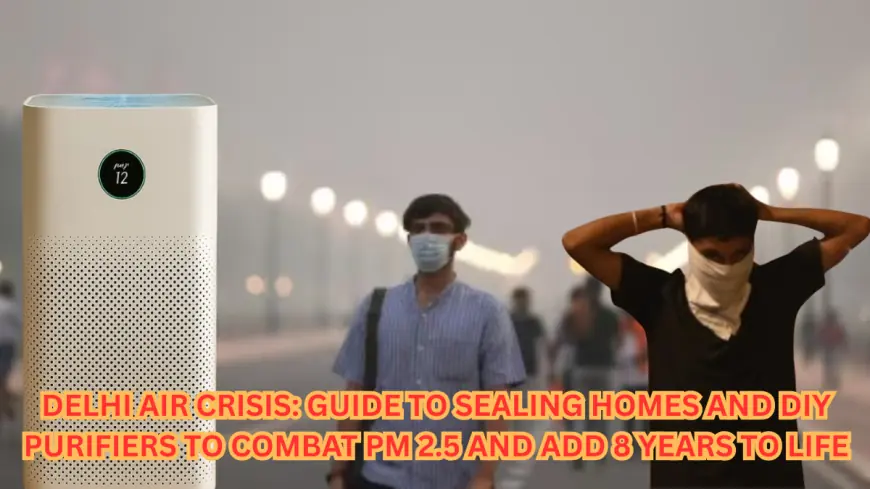
Taking Control of the Air You Breathe: A Critical Guide for North Indian Residents
New Delhi, December 1, 2025 – With air pollution in North India linked by doctors to fatality rates exceeding those of COVID-19, and the toxic air in the National Capital Region (NCR) equated to smoking seven cigarettes a day, citizens cannot afford to wait for government action. While initiatives like costly, ineffective cloud seeding and alleged localized water spraying to temporarily manipulate Air Quality Index (AQI) monitors continue, the primary defense against the crisis must begin at home. This guide provides a critical, actionable framework to seal your living space and drastically cut indoor PM 2.5 levels by half or more.
Understanding the Invisible Threat: PM 2.5 and Safe Thresholds
Identifying the Primary Culprit: What is PM 2.5?
PM 2.5 refers to particulate matter smaller than $2.5$ micrometers—roughly 30 times smaller than a human hair. This mix of solid bits and liquid droplets (including sulfates, nitrates, black carbon, and dust) floats easily in the air, allowing it to bypass natural human defenses. Once inhaled, PM 2.5 enters the lungs, then the bloodstream, and finally major organs like the heart and brain, causing silent, cumulative damage. Exposure is strongly linked to a rise in conditions like asthma, heart attacks, strokes, lung cancer, and diabetes.
Measuring Your Air: Key Metrics
Taking control starts with measurement. A quality air quality monitor (costing between ₹3,000 to ₹6,000) is a crucial one-time investment. Focus on two key metrics:
-
PM 2.5 (micrograms per cubic meter): The World Health Organization (WHO) targets an annual average below $5\mu g/m^3$, but a more realistic indoor red line target for highly polluted regions like North India is under $20\mu g/m^3$.
-
CO2 (parts per million or PPM): Important for managing ventilation in sealed homes.
During peak pollution events, outdoor levels often exceed $200\mu g/m^3$, making the mission to drop indoor air quality to below $20\mu g/m^3$ a life-saving imperative.
Immediate Action: Sealing and Smart Cleaning
Step 1: Controlling Infiltration by Sealing
Studies show that outdoor air infiltration accounts for a massive $54$ to $96$ percent of indoor PM 2.5. The most immediate action is to close all windows and doors. This alone can drop indoor levels by $12$ to $76$ percent during peak pollution times by stopping airflow and allowing particles to settle.
Crucially, seal all gaps around windows and doors using foam or rubber weather-stripping, as PM 2.5 can easily sneak through small cracks. Rubber seals are often the most effective.
Step 2: Managing Indoor CO2
Sealing your home can lead to the buildup of exhaled $\text{CO}_2$. While the normal outdoor level is $400\text{ PPM}$, a sealed room can quickly rise to $1,500$ to $2,000\text{ PPM}$, causing symptoms like tiredness, difficulty focusing, and slow decision-making.
To manage this, practice smart ventilation: when outdoor pollution apps indicate a temporary dip (often during the daytime), open windows wide for $10-15$ minutes to create a cross-flow and rapidly drop $\text{CO}_2$ levels. Close the windows quickly before PM 2.5 levels jump too high.
Step 3: Cleaning Without Spreading Dust
Never use a dry broom or sweep during pollution season, as this vigorously stirs up settled particles. A South Korea study showed sweeping increased PM 10 levels eightfold, from $50$ to $400\mu g/m^3$.
Instead, use a wet mop or a damp cloth to capture settled particles. For deeper cleaning, invest in a vacuum cleaner equipped with a HEPA filter, which traps PM 2.5 particles and prevents their re-release into the air.
Buying vs. Building: Effective Air Purification Solutions
Choosing a Commercial Air Purifier
An air purifier is a simple machine: a fan that pulls air through a filter. When buying, ignore marketing gimmicks like ionizers, UV, or ozone generators (ozone can harm the lungs). Focus on the filtration technology:
-
Filtration: Demand a True HEPA H13 filter, which is certified to remove $99.95$ percent of all PM 2.5. Look for an added layer of activated carbon to remove Volatile Organic Compounds (VOCs) from paints and cleaners.
-
Performance: Check the Clean Air Delivery Rate (CADR), measured in cubic feet per minute. For a $300$ square foot room with an $8$-foot ceiling, aim for a minimum of $200\text{ CADR}$. Prioritize placing the purifier in the bedroom where you spend $8$ hours sleeping.
-
Maintenance: Ensure the replacement filters are affordable, as they must be changed every 6 to 12 months to keep the machine effective.
The DIY Solution: Building the Corsi-Rosenthal Box
For those on a tighter budget, a highly effective solution is the Corsi-Rosenthal Box. This build costs less than ₹7,000 and can match the power of commercial units:
-
Materials: One box fan (₹1,000–₹1,500) and four True HEPA H13 filters (approx. ₹5,000 for four).
-
Assembly: Tape the four filters together in a cube shape, and then seal the box fan on top, ensuring all gaps are closed with tape or cardboard. The fan blows air up after it has been pulled through the filters. U.S. research has shown this setup can cut PM 2.5 by $73$ percent.
Indoor Sources and Misconceptions
The Hidden Danger: Indoor Combustion
The worst indoor pollution comes from combustion sources like cooking, incense, and candles. Burning incense in a small room can send PM 2.5 levels soaring to over $779\mu g/m^3$, worse than street levels. Gas stoves also release $\text{CO}$, $\text{NO}_2$, PM 2.5, and 21 VOCs, increasing the risk of childhood asthma by $42$ percent.
The Cooking Ventilation Protocol (The Two-Minute Rule)
You cannot stop cooking, but you can manage the pollution:
-
Protocol: Open kitchen windows and run the exhaust fan during all cooking. Crucially, keep the exhaust fan running for 15 minutes after cooking finishes to clear pollutants and help manage $\text{CO}_2$. Use your air quality monitor to test and confirm the efficacy of this protocol.
The Plant Myth
While plants like aloe and money plant can remove some $\text{CO}_2$ and $\text{VOCs}$, they are not a primary solution for PM 2.5. To remove significant amounts of VOCs, you would need hundreds of plants per square meter, which is impractical. Plants are great for aesthetics and mental well-being, but they cannot replace a true HEPA filter in a crisis environment.
Conclusion: Five Steps to Reclaim Your Health
Following these five steps offers the most powerful, immediate defense against North India’s toxic air, potentially adding 8–10 years to your life:
-
Measure: Track PM 2.5 and $\text{CO}_2$ using a monitor or purifier screen.
-
Seal and Clean: Seal all gaps in doors/windows. Wet mop or use a HEPA vacuum; never dry sweep.
-
Purify: Buy a True HEPA H13 purifier or build a Corsi-Rosenthal Box.
-
Maintain: Change filters regularly every 6–12 months.
-
Control Sources: Use an exhaust fan for 15 minutes post-cooking. Avoid using incense and candles indoors.
While individual action is vital for personal health, continued advocacy and joining protests to demand real change from the government on external pollution sources (cars, stubble burning, factories) remains necessary for a long-term solution.